+ How do I read a ScaleFibre transceiver part number?
The part number shows the form factor, data rate, protocol, media type, connector and coding. For example, PO-OS-800GE-DR8-2MPO-FN-CN is an OSFP (OS), 800G Ethernet (800GE), DR8 module with two MPO-12 connectors (2MPO) and a finned top (FN). The suffix shows the coding: C for coding, then a letter for the vendor. CN is NVIDIA coding and CC is Cisco coding.
+ What does NVIDIA-coded mean?
An NVIDIA-coded module has an EEPROM identity that NVIDIA Cumulus, Spectrum and Quantum switches accept. The switch does not show an “unsupported module” alarm. The coding changes only the EEPROM data. It does not change the laser, the fibre interface or the DSP. The module meets the same MSA electrical and optical specifications.
+ Which switch-vendor codings can I order?
You can order each module with one of these codings: NVIDIA (-CN), Cisco (-CC), Juniper (-CJ), Arista (-CA), HPE / Aruba (-CH), Dell (-CD), Fortinet (-CF) or generic (-CG). The optical module is the same for each coding. Only the EEPROM identity is different. The product pages list the part number for each coding.
+ When do I use a generic (uncoded) module?
Use a generic module (-CG) in a switch that does not check the module EEPROM. Examples are white-box switches, SONiC or DentOS systems, Cumulus Linux on non-NVIDIA hardware, and test labs. The generic module has a neutral EEPROM identity with no vendor-specific data.
+ Can you code a module for a vendor that is not on the list?
Yes. Send us the switch vendor and model. We can supply a module with custom coding. Custom coding has a minimum order quantity and a longer lead time than the standard codings.
+ How do I select the correct form factor?
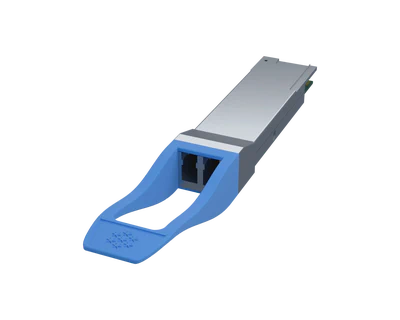
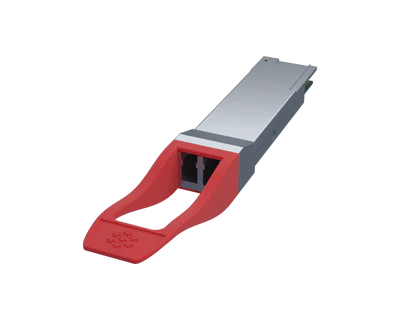
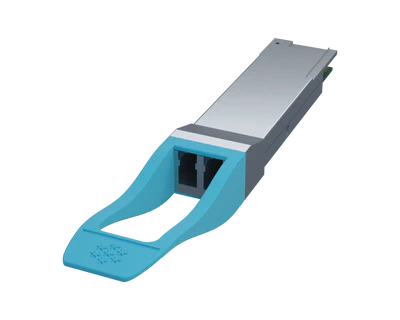
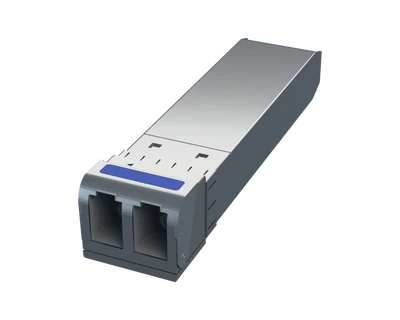
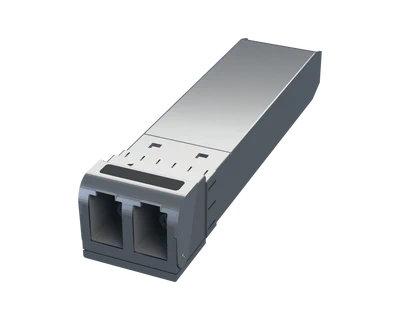
Select the form factor that fits the port on your switch or network adapter. SFP+ has one 10G lane. SFP28 has one 25G lane. QSFP+ has 4 lanes at 10G (40G). QSFP28 has 4 lanes at 25G (100G). QSFP56 has 4 lanes at 50G (200G). These three use the same single-density body. QSFP112 is also single-density and has 4 lanes at 100G (400G). QSFP-DD has a second row of contacts and 8 lanes: 8 × 25G (200G), 8 × 50G (400G) or 8 × 100G (800G). OSFP is a larger body for higher power. It is used for 800G switch ports and for 400G network adapters (flat-top OSFP-RHS). OSFP224 has 8 lanes at 200G (1.6T).
+ What do the reach codes SR, VR, DR, FR, LR, ER and ZR mean?
SR and VR are short reach on multimode fibre, usually 50 m to 100 m on OM4. DR is 500 m on single-mode fibre. FR is 2 km. LR is 10 km. ER is 40 km. ZR is 80 km. A number after the code (for example DR4 or SR8) is the number of optical lanes.
+ How do I know if a module supports Ethernet, InfiniBand or both?
Look at the letters after the data rate in the part number. GE is Ethernet. GI is InfiniBand. GIE is InfiniBand and Ethernet.
+ Do I need a finned or a flat-top module?
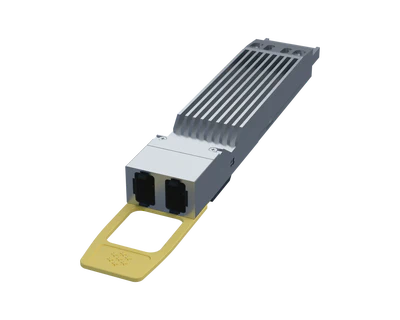
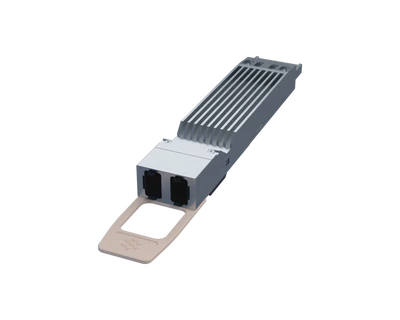
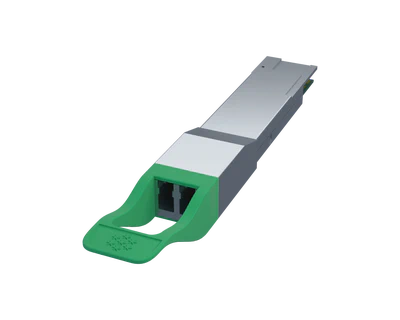
Refer to the datasheet for your switch or network adapter. Most 800G and 1.6T switch ports need a finned (FN) OSFP module, because the module releases its heat through its own fins. Network adapters with a riding heat sink (RHS) need a flat-top module, because the heat sink in the adapter cage removes the heat.
+ What is the difference between a twin-port and a single-port module?
A twin-port module (for example 2×DR4 or 2×FR4) has two optical connectors. Each connector carries an independent link at half the module data rate. You can connect the two links to two different switch ports or network adapters. A single-port module has one optical link at the full data rate.
+ What operating temperature do the modules support?
All standard modules have a commercial temperature range of 0 °C to +70 °C. We can supply industrial-temperature modules (-40 °C to +85 °C) on request. Send us your requirement.